
Refractive errors are the most common cause of vision problems worldwide — and fortunately, among the most correctable. Whether you struggle to read a book, recognise faces across a room, or find yourself squinting at screens, the underlying cause is very often a refractive error. At Krishna Eye Care Centre, we provide thorough refraction assessments and specialist consultation to ensure every patient receives the most accurate correction for their vision needs.
What Is a Refractive Error?
The eye works like a camera. For vision to be clear, light entering the eye must focus precisely on the retina — the light-sensitive layer at the back of the eye. A refractive error occurs when the shape of the eye, the curvature of the cornea, or the focusing power of the lens prevents light from landing exactly where it should. The result is blurred, distorted, or strained vision.
Refractive errors are not a disease. They are optical imperfections that can be corrected with spectacles, contact lenses, or in eligible patients, refractive surgery.
Types of Refractive Errors
Myopia (Short-Sightedness) In myopia, the eyeball is slightly too long or the cornea is too curved. Light focuses in front of the retina instead of on it. Distant objects appear blurry while near objects remain clear. Myopia typically develops in childhood or adolescence and may progress through the teenage years before stabilising.
Common signs include:
- Difficulty seeing the board at school or reading signs at a distance
- Squinting to see far away
- Headaches after activities requiring distance vision
- Sitting closer to the television
Hyperopia (Long-Sightedness) In hyperopia, the eyeball is slightly too short or the cornea is too flat. Light focuses behind the retina. Mild hyperopia can be compensated by the eye’s own focusing mechanism, but this causes eye strain, especially for near tasks. Severe hyperopia affects both distance and near vision.
Common signs include:
- Difficulty focusing on near objects such as books or phones
- Eye strain and headaches after reading or screen use
- Blurred vision at all distances in higher degrees
- Children with significant hyperopia may develop a squint (strabismus)
Astigmatism Astigmatism occurs when the cornea or lens is not perfectly round but more oval in shape — like the surface of a rugby ball rather than a football. This causes light to focus at multiple points rather than one, resulting in blurred or distorted vision at all distances. Astigmatism commonly occurs alongside myopia or hyperopia.
Common signs include:
- Blurred or distorted vision at all distances
- Difficulty reading, with letters appearing to run together
- Eyestrain and headaches
- Difficulty with night driving, including haloes and glare around lights
Presbyopia (Age-Related Reading Difficulty) From around the age of 40, the natural lens of the eye gradually loses its flexibility, making it harder to focus on close objects. This is a normal part of ageing and affects virtually everyone to some degree. It is not a disease, but it does require correction — typically in the form of reading glasses or multifocal lenses.
Common signs include:
- Holding reading material at arm’s length to see clearly
- Difficulty reading small print, especially in low light
- Eyestrain or headaches after prolonged near tasks
- Needing brighter light than before for reading
How Are Refractive Errors Diagnosed?
Diagnosis is straightforward and non-invasive, involving a standard eye examination.
The assessment includes:
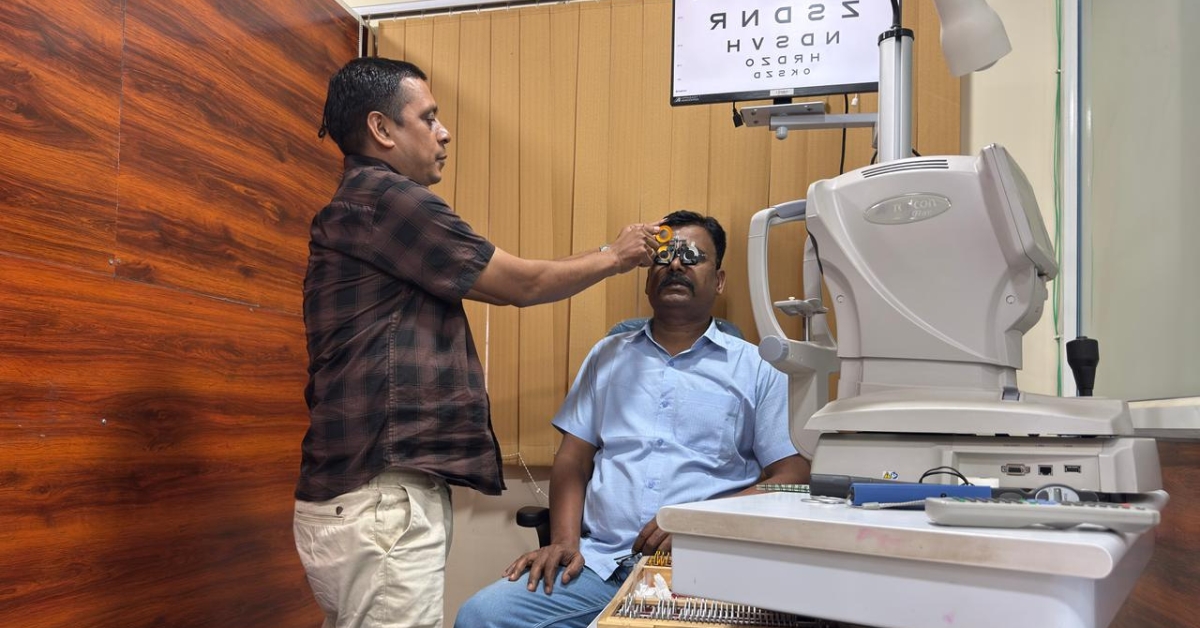
- Visual Acuity Testing — measuring how clearly you can see at distance and near using a standard chart
- Autorefraction — an automated machine that provides an objective estimate of your refractive error
- Subjective Refraction — the classic “which is clearer, one or two?” test, fine-tuning the prescription to what feels best for you
- Slit Lamp Examination — to rule out any structural abnormalities of the cornea or lens contributing to the blurring
- Retinoscopy — particularly useful in children who cannot reliably respond to subjective testing
- Cycloplegic Refraction — eye drops are used to temporarily relax the focusing muscle, giving a more accurate reading especially in children and young adults with high accommodation
Correction Options
Spectacles The simplest, safest, and most widely used method of correcting refractive errors. Modern lens options include single vision, bifocal, progressive (multifocal), anti-reflection coated, and photochromic lenses. A precise prescription is the foundation of good spectacle correction.
Contact Lenses Contact lenses sit directly on the eye and provide a wider field of corrected vision than spectacles. They are available in daily disposable, monthly, toric (for astigmatism), and multifocal varieties. Proper hygiene and fitting guidance are essential to avoid complications.
Refractive Surgery For eligible patients who wish to reduce or eliminate dependence on spectacles or contact lenses, refractive surgery is an option. Common procedures include LASIK, LASEK, PRK, and implantable collamer lenses (ICL). Suitability depends on corneal thickness, prescription stability, age, and overall eye health. Dr Meha Kantha can assess your eligibility and provide appropriate referral for surgical correction.
Refractive Errors in Children
Children often do not realise their vision is abnormal — they simply assume the world looks the way they see it. Uncorrected refractive errors in childhood can lead to:
- Amblyopia (Lazy Eye) — the brain suppresses input from a poorly focused eye, causing permanent vision reduction if not treated early
- Strabismus (Squint) — significant uncorrected hyperopia is a common cause of convergent squint in children
- Learning difficulties — poor vision directly impacts reading, writing, and classroom performance
- Headaches and eye strain — children may complain of tiredness or head pain rather than reporting blurred vision
We recommend a comprehensive eye examination for all children before starting school and regularly thereafter. Early correction gives the visual system the best possible chance to develop normally.
Refractive Errors and Screen Time
In the modern era, prolonged screen use — whether smartphones, tablets, laptops, or televisions — places sustained demand on the eye’s focusing system. While screens do not cause refractive errors directly, they can:
- Reveal or worsen eye strain in patients with uncorrected or under-corrected refractive errors
- Contribute to digital eye strain (computer vision syndrome) with symptoms including tired eyes, headaches, blurred vision, and dry eyes
- Accelerate myopia progression in children, particularly when combined with limited outdoor activity
The 20-20-20 rule is a useful habit: every 20 minutes of screen use, look at something 20 feet away for at least 20 seconds.
Frequently Asked Questions
Q: Do spectacles weaken your eyes over time?
No. This is a very common misconception. Spectacles correct the optical imperfection of the eye but do not change the underlying structure. Your prescription may change over time due to natural growth (in children) or age-related changes, but spectacles themselves do not cause or worsen refractive errors.
Q: My child has been prescribed glasses but refuses to wear them. Does it matter?
Yes, it matters significantly — especially in younger children. Uncorrected refractive errors in childhood can lead to permanent vision loss through amblyopia. Consistent wear of the prescribed spectacles is essential for healthy visual development. If your child is reluctant, speak to your doctor about ways to encourage compliance.
Q: Can refractive errors be prevented?
The underlying cause of most refractive errors — the shape of the eye — is largely determined by genetics and cannot be prevented. However, myopia progression in children can be slowed through increased outdoor time, myopia control spectacle lenses, orthokeratology, and certain eye drops such as low-dose atropine. Speak to Dr Meha Kantha about myopia management options for your child.
Q: At what age can someone have refractive surgery?
Most refractive surgeons require patients to be at least 18 to 21 years old, with a stable prescription for at least 1 to 2 years before surgery. This ensures the eye has finished growing and the correction is likely to be lasting. A full pre-surgical assessment determines suitability on an individual basis.
Q: I am over 50 and need both distance and reading glasses. Is there a single solution?
Yes. Progressive (multifocal) spectacle lenses correct distance, intermediate, and near vision in one lens without a visible line. Multifocal contact lenses are also available. For patients who have had or are considering cataract surgery, premium intraocular lens implants can correct presbyopia at the time of surgery. Your options depend on your overall eye health and lifestyle needs.
Q: How often should I get my eyes tested?
Adults with no known eye conditions should have a comprehensive eye examination every 2 years. Those with existing refractive errors, a family history of eye disease, diabetes, or other risk factors should be seen annually or as advised by their eye doctor. Children should be examined before starting school and every 1 to 2 years thereafter.
Q: Are refractive error consultations available in Patna?
Yes. Comprehensive refraction assessments and specialist consultations for all refractive errors are available at Krishna Eye Care Centre, Dr K K Kantha Memorial Hospital, Patna.
Book a Consultation
Clear vision makes an enormous difference to quality of life — at school, at work, and every day. If you or your child are experiencing blurred vision, headaches, eye strain, or difficulty with distance or near tasks, a comprehensive eye examination is the first step.
📞 +91 893 583 4142 | +91 886 400 4584
📍 21 B/3, Patliputra Colony, Near Pataliputra Golambar, Opp. UNICEF Building, Patna 800 013
🌐 Book online at kanthahospital.com