

A Treadmill Test — commonly referred to as a TMT, stress test, or exercise ECG — is one of the most important non-invasive tools available for evaluating how your heart performs under physical demand. While a resting ECG captures the heart’s electrical activity when it is relaxed, the TMT reveals what happens when the heart is asked to work harder. Blockages in coronary arteries that produce no symptoms and no ECG changes at rest can become clearly visible during the controlled physical stress of a treadmill test.
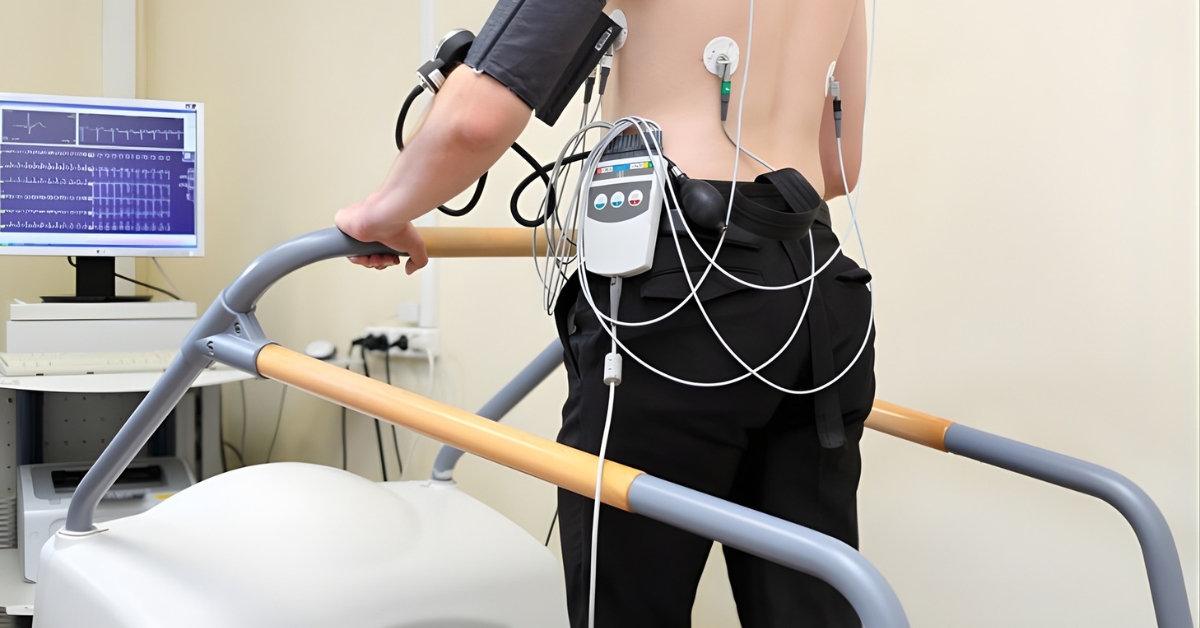
At Vikram Heart Care Centre, TMT is performed and interpreted by Dr Kushaal Vikram, giving patients in Patna access to expert-level cardiac stress testing with real-time specialist oversight.
What Is a TMT?
A Treadmill Test is a cardiac stress test in which the patient walks on a treadmill at progressively increasing speeds and inclines while their heart rate, blood pressure, and ECG are monitored continuously. As the workload increases, the heart demands more oxygen-rich blood from the coronary arteries. If any of those arteries are significantly narrowed by plaque (atherosclerosis), the increased demand cannot be met — and this mismatch shows up as characteristic changes on the ECG, symptoms such as chest pain or breathlessness, or abnormal blood pressure responses.
The test follows a standardised protocol — most commonly the Bruce Protocol — which increases the treadmill speed and incline in stages every three minutes. The test continues until the target heart rate is reached, significant ECG changes appear, symptoms develop, or the patient is unable to continue safely.
Why Is the TMT Important?
Many patients with significant coronary artery disease have a completely normal resting ECG and no symptoms at rest. The heart is efficient enough at low demand levels to compensate for moderate blockages. It is only when the demand increases — during exercise, exertion, stress, or even emotional excitement — that the limitation becomes apparent.
The TMT bridges this diagnostic gap. It is the most accessible and widely available method for unmasking exercise-induced ischaemia — reduced blood flow to the heart muscle that only occurs under demand.
What the TMT Assesses
ECG Changes During Exercise The most important component. ST segment depression during exercise is the classic sign of myocardial ischaemia — indicating that a region of the heart muscle is not receiving adequate blood flow when under stress.
Symptoms During Exercise Chest pain, chest tightness, breathlessness, dizziness, or unusual fatigue during the test are important clinical findings that are factored into the overall interpretation.
Heart Rate Response How the heart rate rises during exercise and recovers after stopping provides important information about the cardiac and autonomic nervous system.
Blood Pressure Response Blood pressure normally rises moderately during exercise. An exaggerated rise (hypertensive response) or a drop in blood pressure during exercise (a concerning sign) are both diagnostically important.
Exercise Capacity How long the patient can exercise and at what workload — expressed in METs (metabolic equivalents) — is a strong and independent predictor of cardiovascular risk and overall prognosis.
Heart Rate Recovery How quickly the heart rate drops in the first minute after stopping exercise is a marker of autonomic function and has prognostic significance.
Conditions Investigated by TMT
Coronary Artery Disease (CAD) The primary indication. The TMT is used to detect significant narrowing of the coronary arteries in patients with chest pain, atypical symptoms, or multiple risk factors where a resting ECG is normal or non-diagnostic.
Chest Pain Evaluation Determining whether chest pain on exertion (angina) has a cardiac cause. A positive TMT in this context strongly supports the diagnosis of obstructive coronary artery disease and guides the next steps in management.
Risk Stratification After Heart Attack Following a heart attack, a submaximal or symptom-limited TMT is used to assess the extent of residual ischaemia, functional capacity, and the risk of future cardiac events before returning to normal activity or work.
Hypertension Evaluating the blood pressure response to exercise in patients with known or suspected hypertension, and identifying exercise-induced hypertension in patients with normal resting blood pressure.
Arrhythmia Assessment Some arrhythmias are provoked by exercise — including certain ventricular arrhythmias and supraventricular tachycardias. The TMT can help characterise exercise-induced arrhythmias and guide management.
Pre-Operative Cardiac Assessment Evaluating functional capacity and identifying occult coronary artery disease before major non-cardiac surgery in intermediate-risk patients.
Fitness and Functional Capacity Assessment Objective measurement of exercise capacity in patients with heart failure, valvular disease, or following cardiac rehabilitation to guide activity levels and monitor progress.
Return to Work or Sport Clearance Providing objective evidence that a patient’s heart can safely manage the demands of their occupation or sporting activity following a cardiac event.
Who Should Have a TMT?
A TMT is recommended in a range of clinical situations. Your cardiologist will advise whether it is appropriate for your specific circumstances.
Common indications include:
- Chest pain or chest tightness on exertion that requires investigation
- Atypical symptoms (jaw pain, arm pain, back pain, indigestion-like discomfort) in a patient with cardiac risk factors
- Known coronary artery disease requiring periodic reassessment
- Evaluation of treatment effectiveness — both medical and after procedures such as angioplasty or bypass surgery
- Multiple cardiovascular risk factors (diabetes, hypertension, smoking, family history, high cholesterol) with no prior cardiac workup
- Pre-operative assessment before major surgery
- Exercise-induced palpitations or arrhythmias
- Assessment of blood pressure response to exercise
- Fitness clearance for high-demand occupations or competitive sport
Who Should NOT Have a TMT?
The TMT is contraindicated in certain situations where exercise would be unsafe. Your cardiologist will screen for these before the test.
Absolute contraindications include:
- Acute myocardial infarction (heart attack) within the past 2 days
- Unstable angina — chest pain at rest or rapidly worsening chest pain
- Uncontrolled severe arrhythmia causing haemodynamic compromise
- Severe symptomatic aortic stenosis
- Acute decompensated heart failure
- Acute pulmonary embolism or deep vein thrombosis
- Acute myocarditis or pericarditis
- Acute aortic dissection
In these situations, alternative investigations such as pharmacological stress imaging are used.
The Procedure: What to Expect
Before the Test
- Wear comfortable, loose clothing and supportive walking or running shoes
- Avoid eating a heavy meal for at least 3 hours before the test
- Avoid caffeine on the day of the test as it can affect heart rate response
- Continue your regular medications unless specifically instructed otherwise by your cardiologist — some medications (particularly beta-blockers) may need to be withheld if the purpose of the test is diagnostic; your cardiologist will advise
- Inform the team of any recent illness, joint problems, or difficulty walking that might affect your ability to exercise
During the Test
- ECG electrodes are attached to your chest and a blood pressure cuff is placed on your arm
- A resting ECG and blood pressure are recorded as a baseline
- You begin walking on the treadmill at a comfortable pace
- Every 3 minutes, the speed and incline increase according to the protocol
- Your ECG is monitored continuously and blood pressure is measured at regular intervals
- You will be asked to report any symptoms immediately — chest discomfort, breathlessness, dizziness, or leg pain
- The test continues until the target heart rate is achieved, significant changes are noted, symptoms develop, or you feel unable to continue
- After stopping, you continue to be monitored during the recovery period for several minutes
After the Test
- You will be asked to rest while monitoring continues until your heart rate and blood pressure return to near-baseline levels
- Your cardiologist will discuss the findings with you
- The entire appointment typically takes 45 minutes to 1 hour
Understanding Your TMT Result
Positive TMT Significant ST segment changes, development of chest pain, abnormal blood pressure response, or serious arrhythmia during the test. A positive result suggests the presence of significant coronary artery disease and typically warrants further investigation — usually coronary angiography.
Negative TMT No significant ECG changes, symptoms, or abnormal haemodynamic responses despite achieving the target heart rate. A negative result is reassuring and significantly reduces the probability of obstructive coronary artery disease.
Inconclusive TMT The test is stopped before the target heart rate is reached due to fatigue, orthopaedic limitations, or other non-cardiac reasons, without definitive positive or negative findings. In this situation, alternative stress testing methods may be recommended.
Equivocal TMT Minor ECG changes that do not meet full diagnostic criteria for a positive test, or borderline findings. Clinical context, risk profile, and further investigation guide management in these cases.
After a Positive TMT
A positive TMT is not a diagnosis of a heart attack or imminent danger — it is a signal that further evaluation is needed. The next step is typically coronary angiography — an imaging procedure that directly visualises the coronary arteries to identify, locate, and quantify any blockages.
Depending on the findings of angiography, management may involve:
- Optimisation of medications
- Coronary angioplasty and stenting (PCI)
- Coronary artery bypass grafting (CABG)
Your cardiologist will guide you through each step with full explanation of options, risks, and benefits.
Frequently Asked Questions
Q: Is the TMT safe?
The TMT is a very safe procedure when performed in an appropriately equipped facility with trained medical staff. Serious complications such as heart attack or severe arrhythmia during testing are extremely rare — occurring in approximately 1 in 10,000 tests. The test is stopped immediately if concerning symptoms or ECG changes develop, and emergency equipment is always available.
Q: How fit do I need to be to have a TMT?
You do not need to be physically fit. The test begins at a very gentle walking pace and increases gradually. Most patients who can walk independently are able to complete a useful portion of the test. If you have significant joint problems, neurological conditions, or other physical limitations that prevent treadmill exercise, your cardiologist will discuss alternative stress testing options.
Q: Should I stop my heart medications before the test?
This depends entirely on the purpose of the test and which medications you take. Some medications — particularly beta-blockers — reduce the heart rate response to exercise and can affect the diagnostic accuracy of the test. Your cardiologist will give you specific instructions about which medications to take or withhold before your appointment. Never stop medications without explicit medical advice.
Q: I had a TMT years ago and it was normal. Do I need a repeat test?
Coronary artery disease can progress over time, and a normal TMT from several years ago does not guarantee the current status of your coronary arteries. If you have new or changed symptoms, worsening risk factors, or it has been a significant period since your last assessment, your cardiologist may recommend a repeat test.
Q: My TMT was positive but I have no chest pain. What does this mean?
Silent ischaemia — reduced blood flow to the heart during exercise without symptoms — is a recognised condition and carries the same clinical significance as symptomatic ischaemia. A positive TMT in the absence of symptoms still warrants further investigation with coronary angiography to determine the extent and significance of any coronary artery disease.
Q: Can women have a TMT?
Yes. However, it is worth noting that the diagnostic accuracy of the exercise ECG is somewhat lower in women than in men, with a higher rate of false positive results. Your cardiologist will take this into account when interpreting your results and may recommend stress imaging (such as stress echocardiography) as an alternative or complementary investigation in selected cases.
Q: Is TMT available in Patna?
Yes. Treadmill stress testing is available at Vikram Heart Care Centre, Dr K K Kantha Memorial Hospital, 21 B/3, Patliputra Colony, Patna.
Book a Consultation
If you experience chest discomfort on exertion, have multiple cardiac risk factors, or have been advised to undergo a stress test, do not delay your assessment. Early detection of coronary artery disease gives you the widest range of treatment options and the best chance of a positive outcome.
📞 +91 893 583 4142 | +91 886 400 4584
📍 21 B/3, Patliputra Colony, Near Pataliputra Golambar, Opp. UNICEF Building, Patna 800 013
🌐 Book online at kanthahospital.com